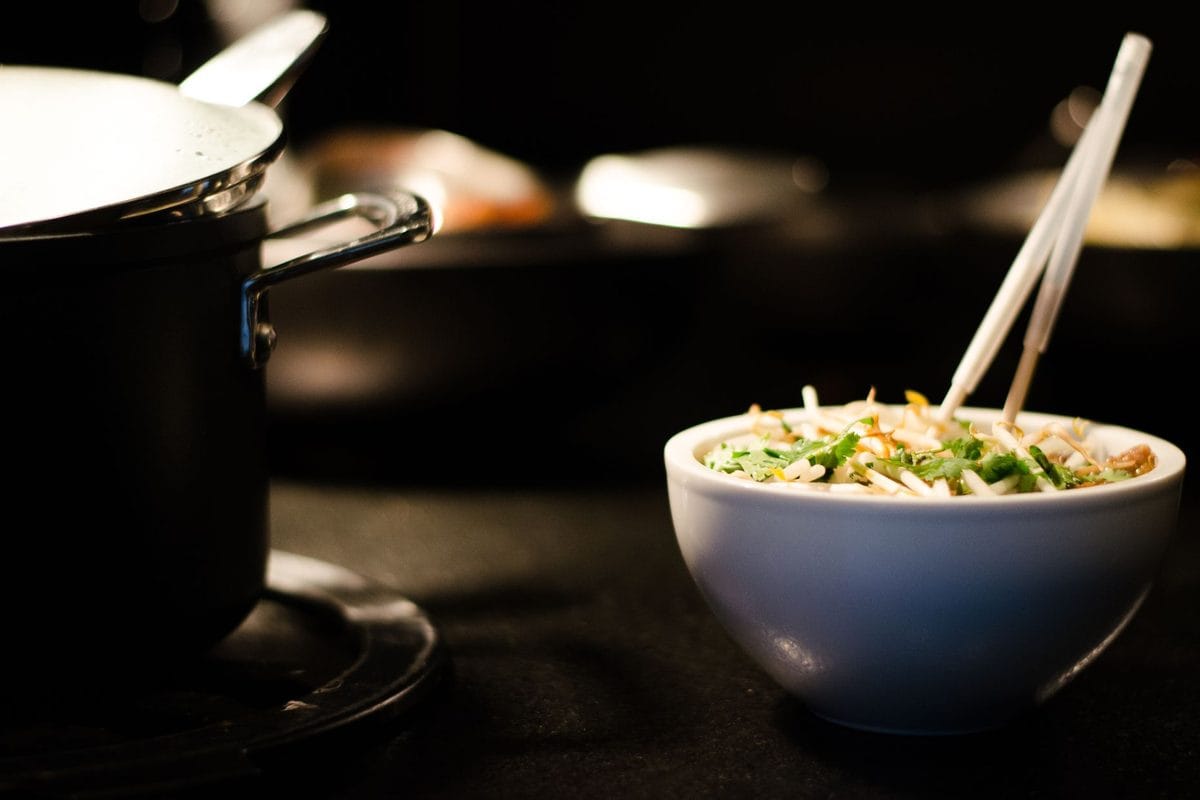
Somewhere over breakfast, a line runs across Asia that most maps miss. On one side, the morning is a plate — toast, eggs, something fried and handheld. On the other, and it's the larger side by far, the morning is a bowl of hot soup, eaten standing at a counter or hunched over a low table before the heat of the day arrives. Cross from Bangkok to Bali, from Hanoi to Hakata, and you're never far from someone slurping their first meal.
This isn't a quirk. A hot, savoury, often spicy soup at 7am does real work in a tropical climate: it rehydrates, it wakes up a sluggish appetite, and it sits lighter through a humid morning than a fry-up ever could. The wisdom is baked into the recipes, even if nobody in the queue is thinking about it.
Vietnam: the bowl that became a flag
Phở is the obvious starting point, and it earns the cliché. A proper bowl in Hanoi is a clear, almost austere beef broth — simmered for hours with charred ginger and onion, star anise and cinnamon, then poured over rice noodles and raw beef that cooks in the heat of the liquid. The southern version in Ho Chi Minh City arrives sweeter and louder, piled with bean sprouts, basil, lime and chilli you add yourself.
But phở isn't even the whole story. In Huế, the breakfast of choice is bún bò Huế — a fierce, lemongrass-and-shrimp-paste broth that makes phở look shy. Ask a Vietnamese person which is the real morning soup and you'll start an argument that has no resolution and never will.
Japan: ramen is dinner, miso is morning
Here's where outsiders get it wrong. Ramen, for all its global fame, is not breakfast food in Japan — it's a late-night or lunchtime thing. The Japanese morning bowl is quieter: miso soup beside a tray of rice, grilled fish and pickles, the classic ichijū-sansai that still anchors a traditional breakfast at a ryokan or an old-school diner.
The exception proves the rule. In Fukuoka, the spiritual home of tonkotsu ramen, you can find the rich pork-bone broth being eaten early — but even there, locals will tell you it's a treat, not a routine. Miso does the everyday work.
A bowl of miso soup contains almost nothing and tastes of everything — fermented soybean, a curl of dried bonito, a few cubes of tofu. It is the most repeated meal in Japan and nobody tires of it.
The Chinese morning, region by region
China splits the breakfast bowl into a dozen dialects. In Guangzhou, it's congee — the slow-cooked rice porridge, smooth as cream, topped with century egg and pork or a fistful of fresh fish. In the north, it's a wheat world instead: a bowl of soy milk, sometimes savoury and curdled with vinegar, eaten with a fried dough stick dunked straight in.
Then there's Lanzhou, whose hand-pulled beef noodle soup is so codified it has near-mythic rules — the broth clear, the radish white, the chilli oil red, the coriander green, the noodles pulled to order in front of you. People queue for it at 7am the way others queue for coffee.
Southeast Asia: the spice gets louder
Move south and the broth turns coconut-rich and chilli-forward. Malaysia and Singapore start the day with laksa, the curry-laksa version drowning rice noodles in a coconut gravy, or the sour asam laksa of Penang that swaps the coconut for tamarind and mackerel. Myanmar has mohinga, a fish-and-lemongrass soup thickened with toasted chickpea flour that is, by quiet consensus, the closest thing the country has to a national dish.
Indonesia counters with soto — and there's no single soto, there are dozens. Soto ayam glows yellow with turmeric and arrives over rice; soto betawi from Jakarta is enriched with coconut or milk; each island, almost each city, claims its own. The catch is that "soto" tells a Jakarta cook and a Surabaya cook to make two genuinely different dishes, and both will insist theirs is the original.
How to eat it like you belong
Three things separate a tourist from a regular at the morning soup counter. First, the condiments are not decoration — the fish sauce, lime, chilli and herbs on the table are how you finish the bowl to your own taste, and the cook expects you to use them. Second, it's a fast meal, not a lingering one; the stool you're on is needed for the next person. Third, the best version is almost never the famous one.
Find the stall with the longest local queue and the shortest menu — usually one soup, maybe two — and order what everyone else is having. That's the bowl that's been refined over thirty years of feeding the same neighbourhood, and it's the one you'll still be thinking about on the flight home.