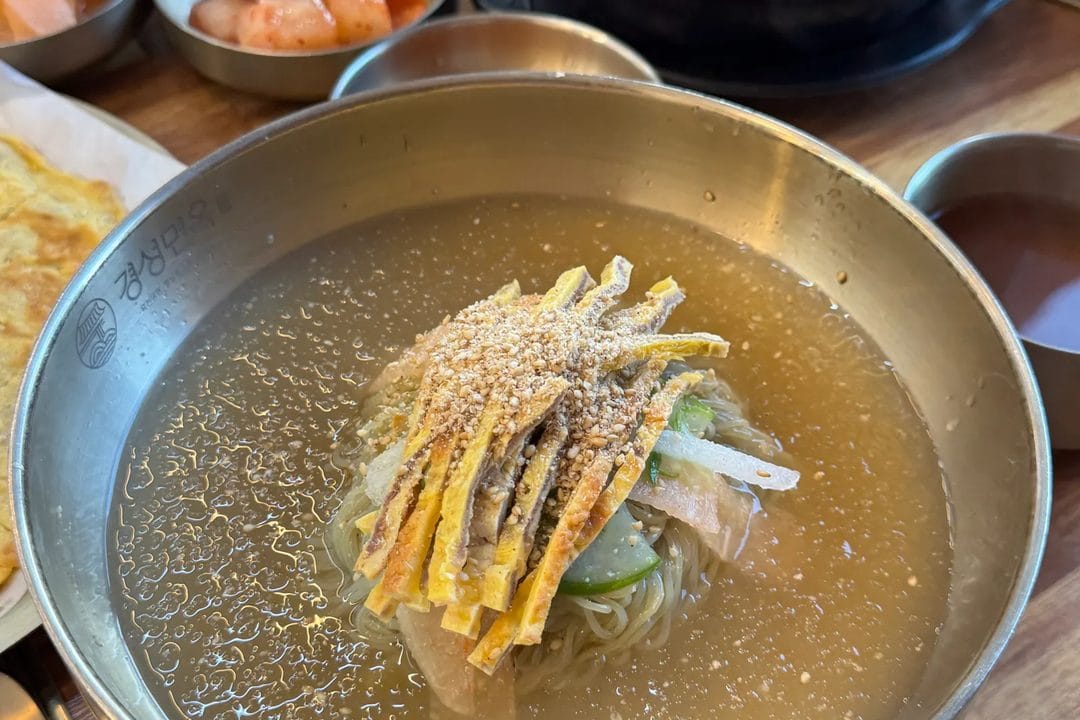
By eleven in the morning, the line outside Eulmildae in Mapo already bends around the corner, and nobody in it is talking about lunch plans — they're talking about which bowl they're getting. Seoul in August sits somewhere between 30 and 34°C with humidity that makes the air feel chewable, and on days like that, the city's answer isn't iced coffee or shaved ice. It's a stainless steel bowl of naengmyeon, cold enough that the surface fogs, arriving with a raw egg half, a few slices of Korean pear, and a pair of kitchen scissors nobody explains to you unless you ask.
Two Cities in One Bowl
What almost nobody outside Korea realizes is that "naengmyeon" isn't one dish — it's a truce between two regional cuisines that no longer exist where they started. Pyongyang-style naengmyeon (평양냉면) is built on thin buckwheat noodles in a translucent, faintly sweet broth traditionally made from beef brisket and dongchimi, the winter radish water-kimchi, chilled until it's barely above freezing. Hamhung-style naengmyeon, by contrast, skips the broth almost entirely: it uses noodles pressed from potato or sweet-potato starch, springy enough to resist a bite, tossed in a gochugaru-based sauce with vinegar and sugar, often piled with hoe — raw skate or flounder marinated until the flesh turns opaque. Order "naengmyeon" without specifying and a Seoul waiter will usually just ask which one you mean.
Neither style is native to Seoul. Both arrived the same way: carried south by people who had no intention of staying, then never got to go home. Pyongyang and Hamhung are two cities in what is now North Korea, and the noodle houses that define naengmyeon today — Woo Lae Oak in Euljiro, Pildong Myeonok in Jung-gu, Eulmildae in Mapo, Nampo Myeonok — were opened by refugees from the 1950–53 Korean War who reconstructed their hometown recipes from memory, using whatever ingredients Seoul's markets could supply. Woo Lae Oak has served its version from the same Euljiro address since 1946, which makes it older than the war itself and gives it a claim that few restaurants in the city can match: it wasn't founded to imitate Pyongyang cooking, it moved with it.
Why the Broth Divides People
Ask a Seoul native which style is correct and you will get an opinion, not a shrug. The Pyongyang camp treats mul naengmyeon — "water naengmyeon" — as an acquired discipline: the broth is meant to taste faint, almost bland on first contact, closer to cold consommé than to anything spicy, and newcomers routinely reach for the vinegar bottle before they've adjusted to it. That reach is, honestly, a mistake worth avoiding. A seasoned bowl at a place like Pildong Myeonok is balanced enough on its own that dumping vinegar in before the first few bites just flattens the beef broth's depth into acid and nothing else. Try three or four spoonfuls plain first. If it still tastes thin to you after that, then reach for the condiments — that's what they're there for.
The Vinegar-and-Mustard Ritual
Every table setting for naengmyeon comes with two small bottles: rice vinegar and hot yellow mustard, sometimes labeled simply 식초 and 겨자. The ritual isn't optional so much as personal — most regulars add a capful of mustard directly into the broth partway through the bowl, letting the sharpness bloom as the noodles warm slightly against the metal. Vinegar goes in for brightness, mustard for heat that doesn't compete with spice so much as clear the sinuses. Scissors matter here too: buckwheat naengmyeon noodles are notoriously long and springy, cut deliberately short by the kitchen or by the diner so the strands don't act like elastic bands halfway to your mouth.
- Add vinegar first, taste, then add mustard — reversing the order tends to mute the vinegar's brightness
- A pinch of the noodle water itself (the starchy liquid left after boiling) is sometimes poured back into bibim-style bowls to loosen a sauce gone too thick
- Ice shards floating in mul naengmyeon are meant to melt slowly through the meal, not be crunched — though plenty of regulars do it anyway
Hamhung's Sharper Cousin
Bibim naengmyeon reads as the louder, more forgiving version, and it usually is. The potato-starch noodles hold their bite even after minutes in the sauce, the gochugaru dressing brings real heat rather than the Pyongyang bowl's near-silence, and the raw fish on top gives it a chew that has nothing to do with the noodle itself. It photographs better, which has not hurt its popularity with younger diners who find plain mul naengmyeon baffling on a first try. But treating it as simply "the spicy one" undersells what's actually a different noodle technology — starch noodles gelatinize and behave nothing like buckwheat under heat, which is part of why Hamhung-style kitchens rarely serve both from the same broth base.
Here's the part that trips visitors up.
Naengmyeon is not, strictly speaking, a summer dish in its country of origin — in Pyongyang, it was traditionally eaten through the coldest months, the theory being that a very cold bowl in a very cold room felt more intensely refreshing (이열치열 in reverse, if you want the folk logic). Seoul flipped that association decades ago, turning naengmyeon into the city's answer to unbearable heat rather than to biting cold, and today most of the old-school houses do the bulk of their annual business between June and August. Ask an older Pyongyang-style purist about this and some will tell you flatly that eating it in August is backwards — a minority opinion, but not a rare one, and it's the kind of quiet disagreement that keeps naengmyeon conversations in Seoul from ever fully settling.
Price, Status, and the Everyday Bowl
A bowl of naengmyeon in central Seoul in 2026 typically runs ₩12,000 to ₩16,000, with the long-established Euljiro and Mapo houses sitting toward the top of that range and neighborhood spots undercutting it by a few thousand won. That price has climbed noticeably over the past several years — beef prices and buckwheat imports both factor in — and it's now common to hear older customers grumble that a dish once considered working-class lunch food costs roughly the same as a mid-range Korean barbecue portion. Unlike samgyetang, which gets its cultural weight from a fixed calendar slot during the Sambok days of midsummer, naengmyeon carries no such official date. It's simply what people order when the heat becomes a daily problem rather than an occasional one, which in practice means it shows up on tables from late June through early September without anyone needing a holiday to justify it.
That distinction matters more than it sounds. Samgyetang is a ritual food — timed, symbolic, tied to the idea of fighting heat with heat. Naengmyeon has never needed that framing. It's what a construction worker orders on a lunch break in Jongno, what an office team splits after a meeting runs long, what gets delivered to apartments across the city on nights too humid for the stove. The restaurants that do it best haven't changed their recipes to chase trends, and the regulars wouldn't forgive them if they tried — order a bowl at Pildong Myeonok on a Tuesday afternoon and you'll be seated next to people who have been coming for thirty years, ordering the same thing, adding the same capful of mustard at the same point in the meal.