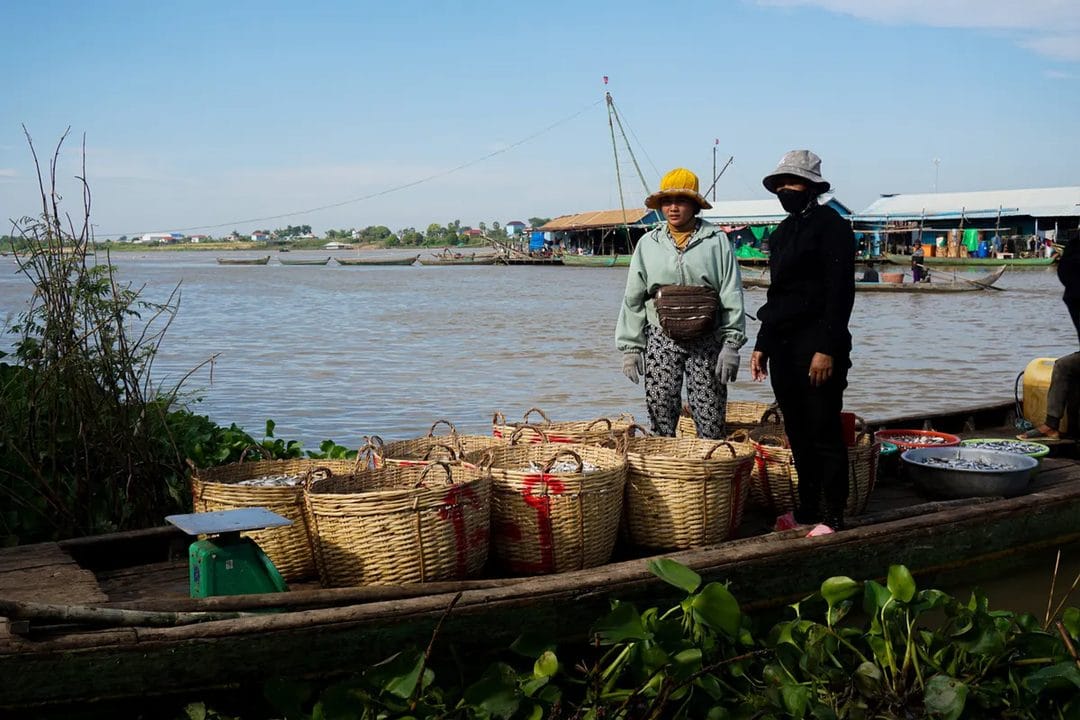
The smell hits before anything else. Walk through the market in Kampong Chhnang province in December, past the stalls of dried fish and palm sugar, and you'll catch it — a low, funky, almost cheese-like note rising off open ceramic jars stacked three high. Vendors scoop dark grey paste with wooden paddles and pack it into plastic bags, weighing it on hand scales the same way their grandmothers did. This is prahok, and it is arguably the single ingredient that decides whether a dish tastes Cambodian or just tastes like something cooked in Cambodia. Skip it, and you're making Thai or Vietnamese food with Khmer names on the menu.
A lake that breathes twice a year
Prahok exists because of a piece of hydrology found almost nowhere else on the planet. Tonle Sap, Cambodia's great lake, is fed by the Tonle Sap River, which connects it to the Mekong — and for four months of the year, the current in that river runs backwards. When the Mekong floods each June, the extra volume has nowhere to go, so it pushes upstream into the lake, more than quadrupling its surface area from roughly 2,500 square kilometres in the dry season to well over 12,000 at the height of the flood. Then, starting in October, the Mekong drops, the river reverses again, and the lake empties itself back out — carrying with it one of the densest freshwater fish migrations on earth. More than a million people live directly off that seasonal rhythm, from the floating villages anchored around Chnok Tru to the rice paddies further inland that flood and drain on the lake's own schedule rather than the calendar.
That emptying is the harvest. From November through January, as the water recedes and channels narrow, fish are forced into smaller and smaller volumes of water, and licensed operators along the Tonle Sap River set up "dai" — huge stationary bag-nets, some of them stretched across the current in batteries of a dozen or more, hauled up every couple of hours around the clock. The catch is dominated by trey riel, a small silvery cyprinid that Mekong River Commission surveys have repeatedly found makes up more than half of the lake's total fish catch by weight. Trey riel is too small and too bony to sell fresh in any real volume — which is exactly why, for at least a few hundred years, Cambodians have turned it into something that keeps.
Pounding, not just fermenting
The word itself gives away the method. "Prahok" comes from the Khmer verb hok, to pound — and pounding, historically by wooden mortar and pestle, is still the defining step that separates prahok from the fish pastes of neighbouring countries. Fresh trey riel is washed, salted heavily, and crushed rather than left whole, breaking down the flesh so salt and enzymes can work through it fast. The mash goes into earthenware jars or, increasingly, food-grade plastic barrels, gets packed down tight to force out air, and is left to ferment anywhere from three months to well over a year depending on the maker and how strong a paste they're after. There's no single fixed recipe for the salt ratio, either — some households run heavier on salt and shorter on time to sell fast at market, while others cut back on salt and let the jar sit for a full year, betting that a longer ferment develops more flavour than a heavier hand with the shaker ever could.
Longer fermentation means a darker colour, a sharper smell, and — according to the Kampong Chhnang producers who supply Phnom Penh's Old Market — a higher price per kilogram. A basic, younger prahok sells for something in the range of $1.50 to $2.50 a kilo at provincial markets; the aged, deep-brown paste favoured by older cooks for its intensity can run closer to $4. Buy the cheap stuff for cooking into a soup base, where its rawness gets tamed by lemongrass and chilli. Save the expensive jar for prahok ktis, where the paste is barely diluted and every flaw or every quality shows.
One ingredient, two very different tables
Raw prahok, straight from the jar, is not something most first-time visitors should attempt — the ammonia note is real, and it takes a palate trained on it to read past the smell to the flavour underneath. That's not snobbery; it's just honest advice. What actually wins people over is prahok ktis: minced pork, coconut milk, a spoon or two of prahok, palm sugar, and kroeung paste simmered down into something closer to a savoury dip, served warm with a plate of raw cucumber, long beans, and other garden vegetables for scooping. It's rich, faintly sweet, and the funk reads more like the back-note of a good aged parmesan than anything off-putting.
Then there's the other end of the spectrum — nom banh chok, Cambodia's breakfast noodle dish, where a fermented fish gravy built on a prahok base gets ladled over rice noodles and fresh herbs, eaten cold, usually before 9am from a woman balancing two baskets on a shoulder pole through the neighbourhood. And there's somlar machu kroeung, a sour soup where a spoonful of prahok dissolved early in the cooking liquid does the same job that fish sauce does in Vietnamese cooking or shrimp paste does in Filipino kitchens: it doesn't taste like fish at all by the time the dish is finished, it just tastes like more of everything else. Ask a Cambodian home cook what makes their soup taste different from a restaurant version, and prahok — how much, how old, whose recipe — is usually the answer.
The ingredient that survived a famine
Prahok kept people alive.
What makes prahok more than a regional condiment is what it meant between 1975 and 1979. Under the Khmer Rouge, rice production was forced upward for export while the people growing it were fed almost nothing, and prahok — salted, dense, calorie-rich, and already sitting in village jars before the regime seized food supplies — became one of the few reliable protein sources available to families who could hide a jar or bury one. Survivors of that period, and their children, talk about prahok less as a flavour and more as a marker of having come through something. A Cambodian living in Long Beach or Melbourne who keeps a jar of prahok in the fridge, however far from Kampong Chhnang, is making a small, specific statement about identity that no amount of fish sauce or shrimp paste quite substitutes for.
Here's the part that surprises outsiders: plenty of Cambodians dislike prahok too, or at least dislike admitting how much of it they actually eat. It sits in a strange cultural spot — essential and slightly embarrassing at once, the ingredient every grandmother's kitchen smells of and the one urban restaurants sometimes downplay on English menus, worried that "fermented fish paste" reads as a warning label to a tourist rather than an invitation. That tension between pride and self-consciousness is, if anything, the most Cambodian thing about the whole dish.
Where the tradition is heading
The dai fishery itself is under real pressure — upstream dams on the Mekong mainstream have already begun changing the flood pulse that the whole system depends on, and Cambodian fisheries researchers have flagged declining trey riel catches over the past decade as one consequence worth watching closely. That's not a reason to panic about prahok disappearing; small-scale aquaculture and imported cyprinids from Vietnam already supplement the wild catch in lean years, and demand for prahok isn't going anywhere as long as Khmer households keep cooking. But it is a reminder that a fermentation tradition this specific to one lake's hydrology isn't guaranteed to run on the same rhythm forever.
If you're traveling through Kampong Chhnang or Kandal province between December and February, the jars stacked outside riverside houses aren't decoration — they're a household's supply for the year, sealed and left to work while everyone gets back to the business of the next harvest. Buy a small bag from whoever's selling at the market rather than a tourist-shop jar in Phnom Penh; you'll pay less and get something that was actually made a few kilometres away instead of trucked in. And don't rinse it before cooking, no matter how strong the smell makes you want to — the salt is doing a job, and washing it away just leaves you with bland fish paste and none of the reason people bother making it in the first place.