Walk into a Nonya kitchen in Katong or Melaka before lunch and the first thing that hits you isn't a smell you can name right away — it's layered, part shrimp paste, part lemongrass, part something dark and slow-cooked that's been on the stove since dawn. That confusion is the point. Peranakan food was built by cooks who refused to choose between two culinary worlds, and five centuries later it still refuses to be filed neatly under "Chinese" or "Malay" on a menu.
Where the Babas and Nonyas Came From
The story starts with trade, not migration in the usual sense. From the 15th century onward, Chinese merchants — many from Fujian and Guangdong — settled in the port towns of the Malay Peninsula and the Indonesian archipelago: Malacca first, then Penang, then Singapore once the British East India Company set up shop there in 1819. These men married local Malay women, and the households that resulted developed their own hybrid identity: Baba for the men, Nonya (or Nyonya) for the women, Peranakan for the community as a whole. The word itself comes from the Malay "anak," meaning child — Peranakan roughly translates to "locally born," which tells you everything about how this culture saw itself. Not transplanted Chinese, not converted Malay, but something new that only made sense in the Straits.
The kitchen is where that identity got worked out in practice, generation after generation, mostly by women who never wrote a recipe down. A Nonya learned rempah — the wet spice paste that underpins nearly every Peranakan dish — by standing next to her mother-in-law and adjusting a pestle grind by feel, not by measurement. Marrying into a Peranakan family historically meant being judged on your rempah before you were judged on anything else; a girl who couldn't pound a balanced paste was, by the old standard, not ready to run a household. That's not folklore dressed up for tourists — it's documented in oral histories collected across Melaka and Penang well into the 20th century, and it explains why so much of this cuisine still resists being reduced to a written recipe card.
Rempah: The Technique That Defines Everything
Every Nonya kitchen has its own version, and this is where the arguments start.
If you want to understand what makes Peranakan food distinct from both of its parent cuisines, start with rempah rather than with any single dish. It's a wet spice paste pounded from shallots, garlic, galangal, fresh turmeric, lemongrass, candlenut and dried chilli, usually with belacan — fermented shrimp paste — toasted and worked in at the end. Chinese cooking of the same period rarely built a dish around a raw aromatic paste fried until the oil separates out; that technique is Malay and Indonesian in origin. But Peranakan cooks paired it with distinctly Chinese ingredients and equipment — pork, soy sauce, the wok, the clay claypot — in combinations that neither tradition would have produced on its own. Ask three Peranakan grandmothers in Melaka how many candlenuts belong in a base rempah and you'll get three different answers, all delivered with total confidence.
Some families skip galangal in favour of extra ginger; others consider that close to heresy. The paste isn't standardised because it was never meant to be — it's a signature, closer to a family crest than a formula, and restaurants that sell "authentic" bottled rempah are selling a compromise, not the real thing.
Ayam Buah Keluak: The Dish That Explains the Whole Cuisine
No ingredient tells the Peranakan story better than buah keluak, the black nut from the Pangium edule tree that grows across Sumatra and the Malay Peninsula. Raw, it's lethal — the kernel contains hydrogen cyanide compounds that have to be leached out over days of soaking, boiling and fermenting in ash before it's safe to eat. Once processed, it turns into something that tastes like a cross between truffle and dark chocolate with a mineral, almost smoky finish, and the traditional way to eat it is to scoop the paste out of the shell with a spoon or your finger after it's simmered for hours in a rempah-based gravy with chicken — ayam buah keluak, arguably the single dish most associated with Peranakan cooking anywhere in the world.
This is not a dish Chinese cooking produced on its own, and it's not one Malay cooking produced either — it required a community willing to spend three days detoxifying a poisonous nut for the payoff of a flavour nothing else replicates. That's the Peranakan sensibility in a single ingredient: patience treated as a technique, not a virtue you talk about.
Babi Pongteh, Kueh, and the Rest of the Table
Pork is where the Peranakan departure from Malay cooking is most obvious, since Malay cuisine is overwhelmingly halal and pork-free. Babi pongteh — pork belly and shiitake mushrooms braised slowly in fermented soybean paste (tau cheo) and dark palm sugar (gula melaka) until it turns glossy and almost sticky — is a dish no Malay household would cook and no mainland Chinese braise quite resembles either, because the sweetness-forward, gula melaka-heavy finish is a Southeast Asian addition. The same logic runs through babi asam, a sour-and-sweet pork stew built on tamarind and rempah, and through itik tim, a duck-and-salted-vegetable soup that Peranakan families traditionally serve at birthdays because the sourness is thought to bring luck.
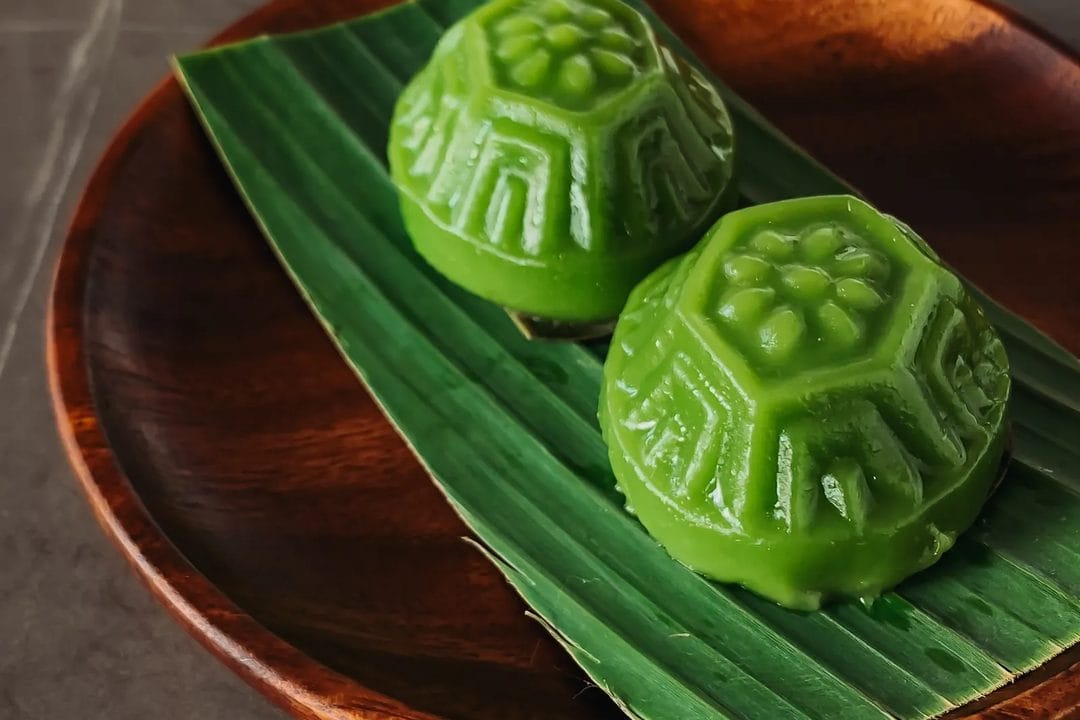
Kueh — the broad family of steamed, layered or pan-fried sweets — is where the Peranakan obsession with colour and texture shows up most visibly. Pandan gives kueh dadar its green, blue butterfly-pea flower tints kueh salat, and gula melaka runs through half the dessert menu as a caramel-adjacent syrup that's less sweet and more mineral than white sugar. Kueh lapis, the multi-layered steamed cake, can take nine or more separate steaming passes to build — one layer poured, steamed until just set, then the next poured on top, repeated until the block is tall enough to slice into stripes. It's the kind of dish that punishes shortcuts, and you can taste the difference between a version steamed properly and one someone rushed through in half the time.
- Laksa lemak — coconut-based, turmeric-heavy noodle soup, distinct from Penang's tamarind-sour asam laksa
- Chap chye — mixed vegetables braised with fermented soybean and wood ear mushroom
- Sambal udang — prawns in a chilli-shallot sambal, usually served with the shells left on for flavour, not convenience
- Kueh pie tee — crisp pastry cups filled with julienned turnip, prawn and egg, eaten in one bite and, in most Peranakan households, considered impossible to eat gracefully in two
How to Tell It Apart From Its Two Parents
The clearest way to spot Peranakan cooking on a menu is to look for what shouldn't logically be there. Pork with a Malay-style rempah base is one signal. A Chinese braising technique — long, slow, soy-and-sugar-forward — applied to an ingredient like tamarind or belacan that Chinese cooking of the same era barely used is another. A third is presentation: Nonya kitchens historically served on elaborate Nonyaware porcelain, hand-painted in Jingdezhen to Peranakan specification with peonies and phoenixes in pink, green and turquoise, a hybrid object in its own right that shows up in Peranakan museums in Singapore and Melaka today.
Order kari ayam at a generic "Asian fusion" restaurant and you'll usually get a thinned-out, sweetened curry aimed at not offending anyone. Order it at a genuine Peranakan kitchen and the better version arrives thicker, sourer from tamarind, and considerably more assertive with the rempah — that's the dish you actually want, and the safer, blander one isn't worth ordering twice. The same goes for ayam buah keluak: if a restaurant serves it without the shells on the plate for you to scoop yourself, or substitutes a pre-made paste for the whole nut, skip it and find a kitchen that does the three-day process properly.
Where the Tradition Stands Today
Peranakan cuisine is not disappearing, but it is changing hands. UNESCO recognised Peranakan cultural heritage in Singapore's national inventory in the 2010s, and Melaka and George Town's Peranakan quarters have both been folded into UNESCO World Heritage listings that predate that — but heritage status hasn't stopped the number of home cooks who still pound their own rempah by hand from shrinking every decade, as convenience pastes and food processors take over even in families that still call themselves Peranakan. Restaurants such as True Blue Cuisine and Candlenut in Singapore, or Nancy's Kitchen in Melaka, have taken on the job of keeping labour-intensive dishes like kueh lapis and ayam buah keluak on menus at all, charging accordingly — a plate of ayam buah keluak in central Singapore typically runs S$18–S$26, reflecting the buah keluak's cost and the hours it takes to prepare.
You don't need a special occasion to eat this way, and that's worth saying plainly: the best Peranakan food was never banquet food to begin with, it was Tuesday dinner cooked by someone's mother-in-law who happened to be extraordinary at it. Go looking for the version made without shortcuts, and you'll understand within one bite why a cuisine built entirely on refusing to pick a side ended up outlasting both of the ones it borrowed from.