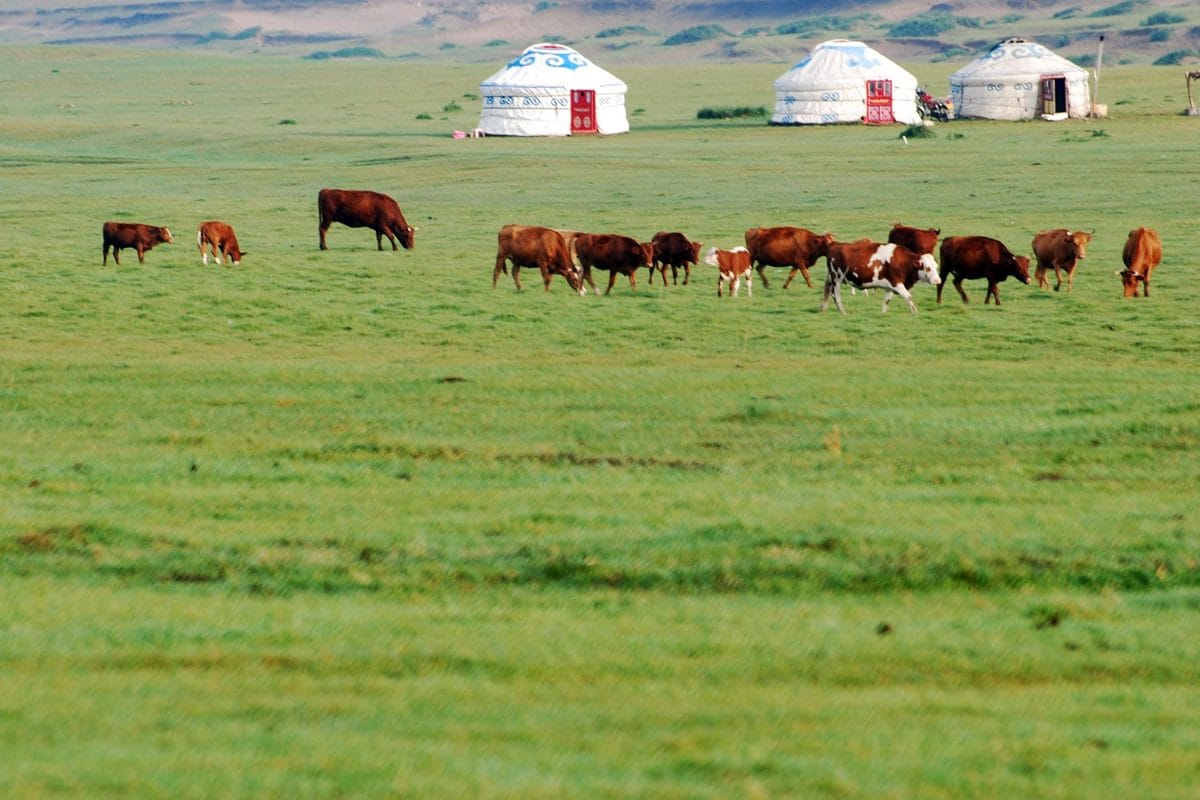
In June, a herding family on the northern edge of the Gobi will spend four straight days doing almost nothing but milking. Mares first, before sunrise, because a nursing foal is let loose just long enough to start the flow and then pulled away again. Then goats, then cows, then the yaks if the household keeps any at that altitude. By the second day the leather sack hanging by the ger door is already sour, and someone — usually whoever walks past most often — gives it a few hundred stirs with a wooden plunger on the way to somewhere else. Nobody calls this cooking. There is no stove involved, no recipe, no chef. It is simply what the calendar demands, and the calendar, not a cookbook, is what actually runs Mongolian food.
That calendar has a name for its two halves: tsagaan idee, white food, and ulaan idee, red food. White food is everything that comes from milk — it dominates the table from late spring through early autumn, while the herds are lactating and the grass is rich enough to support it. Red food is meat, and it takes over once the cold sets in and slaughtering season begins, because a carcass keeps for months in a Mongolian winter without anything as elaborate as a freezer. You will not find a Mongolian menu built around "mains" and "sides" the way a Beijing or Bangkok kitchen thinks about a plate. You'll find a household deciding, almost unconsciously, which half of the year it's currently living in.
The White Season and the Wait for Airag
Nearly everything in the tsagaan idee category starts as the same raw material and ends up somewhere completely different depending on how long it sits and how hard it's worked. Fresh milk gets skimmed for urum, a clotted cream closer to Turkish kaymak than to Western butter. What's left gets soured into tarag, a yogurt thin enough to drink, or boiled down and pressed into aaruul — the hard, sun-dried curd chunks piled in bowls on every windowsill from June onward, chewy enough that Mongolian children learn to work a piece for twenty minutes the way other kids work a lollipop. None of this needs refrigeration, which is the entire point: a nomadic household that relocates two or three times a season cannot depend on anything that spoils.
Then there's airag, and airag is the one that outsiders always ask about first, usually with a slightly nervous laugh once they hear "fermented mare's milk." Mare's milk won't set into cheese or thicken into yogurt the way cow's or goat's milk does — it's too low in casein — so herders have spent centuries doing the one thing that does work with it: agitating it, over and over, in a leather or canvas sack, until wild airag-specific bacteria and yeasts turn the natural sugar into a thin, faintly sour, faintly effervescent drink with a low alcoholic kick. Guests are expected to accept a bowl when it's offered, and refusing outright reads as rude in a way that a polite half-sip and a "thank you" does not. If you're travelling through the countryside between June and August and someone hands you a bowl fresh from that day's churning, drink it — it's nothing like the sweetened, shelf-stable version sold in Ulaanbaatar supermarkets for tourists, and it will not taste the same again once autumn ends the milking season.
Buuz and the Four-Day Assembly Line of Tsagaan Sar
Tsagaan Sar — the Mongolian Lunar New Year, timed to the same lunisolar calendar behind Chinese New Year but usually landing on a different date — is where the calendar flips hardest toward meat, right at the point where a household's dairy has run lowest and its stored winter meat is about to be judged for how well it survived the cold. The centerpiece is buuz, a steamed mutton or beef dumpling pinched into a small purse with a pleated top, and the scale of production is not a family recipe so much as a logistics operation: households routinely fold several hundred of them over the days before the holiday, working in relay shifts, then stack the finished trays on an unheated balcony or porch, which in a Ulaanbaatar winter functions as a perfectly serviceable freezer. The eve of the new year, called Bituun, is when the real eating begins, and buuz are traditionally served and counted in odd numbers on the plate — a superstition nobody bothers explaining anymore, they simply do it.
Beside the buuz sits ul boov or kheviin boov, a tower of fried, sugar-dusted biscuits stacked in odd-numbered tiers — three, five, seven, sometimes nine — with the height signalling the household's standing, and a whole roasted sheep's back, tail fat and all, presented as the meal's centerpiece rather than sliced up beforehand. Every visitor who comes through the door during the following days is fed buuz on the spot, whether they've eaten already or not, and turning it down is close to unthinkable.
Naadam's Two Foods: Khuushuur at the Stadium, Khorkhog Around the Fire
Nobody eats khorkhog quietly.
Naadam runs from the 11th to the 13th of July, UNESCO-recognised since 2010, and it centers on what Mongolians call the "three manly games" — wrestling, horse racing and archery — held simultaneously across the country rather than as one single national event. The festival food, though, splits cleanly along the same white-food-red-food logic as everything else. At the stadiums and along the roadside stalls that spring up for the three days, the dish everyone actually buys is khuushuur: a flattened dough pocket stuffed with minced mutton and onion, then deep-fried until the edges blister and crisp. It's fast, it's handheld, it survives being eaten one-handed while watching a wrestling bout, and it is, honestly, the better introduction to Mongolian food than buuz is — the frying does something to the fat and the crust that steaming never manages, and the flavour holds up even after the pastry's gone lukewarm.
Khorkhog belongs to a different register entirely — this is the dish for a wedding, a family reunion, or a Naadam gathering back at the ger rather than the stadium. Chunks of mutton, potato and carrot go into a sealed metal milk churn or heavy pot along with river stones heated red-hot in an open fire; the lid goes on, the whole thing steams and roasts itself from the inside for close to an hour, and the stones come back out too hot to hold in bare hands, passed from person to person anyway as a kind of edible hot-potato ritual that supposedly aids digestion. Some Mongolian food historians trace the stone-boiling technique itself back to the Stone Age, when heated rocks dropped into a hide-lined pit were the only way to cook liquid at all before metal pots existed — whether or not that lineage holds up to scrutiny, the method has clearly outlasted every technology that was supposed to replace it.
What the City Is Doing to the Countryside's Rules
Ulaanbaatar complicates all of this, because more than half the country's population now lives in a capital where herding is something you visit rather than something you do. Buuz still gets made from scratch before Tsagaan Sar in plenty of apartments, but a growing number of households simply buy frozen trays from a market stall or a dumpling shop that runs the assembly line year-round — which would have been unthinkable a generation ago and now barely registers as a compromise. Restaurants across the capital have also started selling khorkhog as a bookable, tourist-facing experience, complete with a demonstration of pulling the scalding stones out by hand, in a city where most residents haven't personally built a fire to heat them in years. The white-food, red-food calendar hasn't disappeared — supermarket shelves still noticeably shift stock between summer and winter — but it's increasingly something Ulaanbaatar buys into rather than lives inside directly, and that gap between the herding calendar and the apartment kitchen is only going to widen.
Out on the steppe itself, though, none of that has changed the actual rhythm much. The milking still starts before dawn in June, the sacks by the door still get their few hundred stirs on the way past, and somewhere a family is already three days into folding buuz for a new year that, this far from any city, still runs on when the animals are lactating and when they aren't.