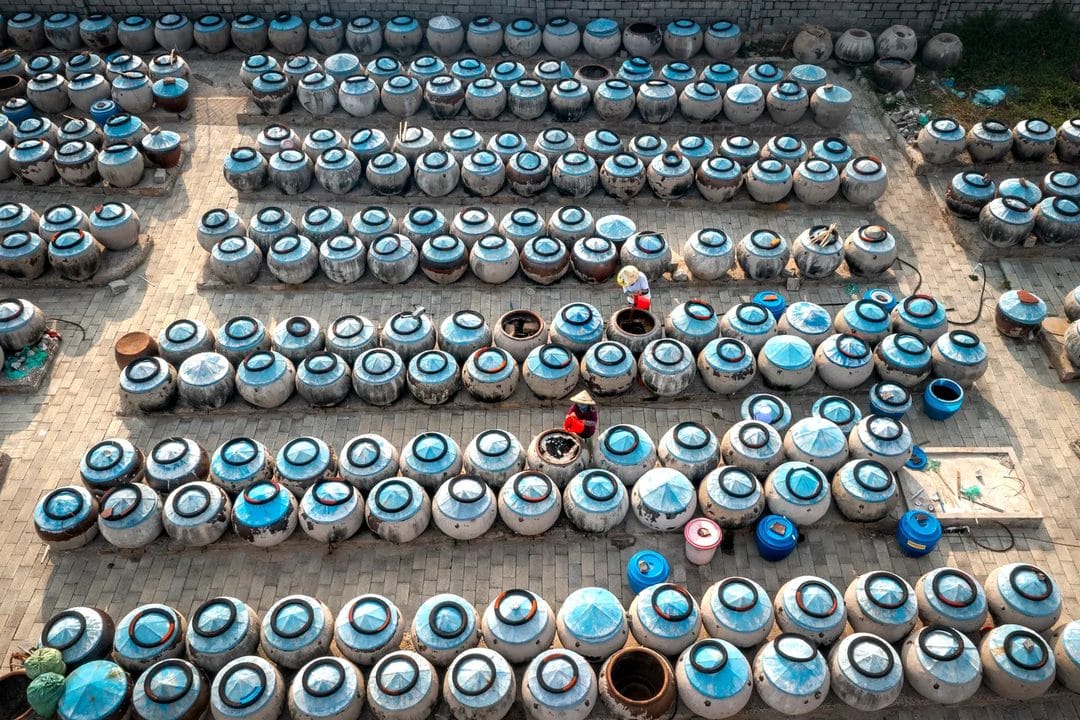
By nine in the morning, the barrel houses on Phú Quốc already smell like the tide went out and forgot to come back. Rows of wooden vats taller than a person sit under corrugated roofs, each one packed with anchovies and salt in a ratio nobody writes down anymore because everyone in the family already knows it by heart. Nothing moves, and nobody stirs the mixture — the barrels just sit there through the hottest months of the year, doing something that looks, to an outsider, exactly like nothing happening at all.
That stillness is the whole point. Late July sits at the center of the working season for Southeast Asia's fish sauce makers, and heat is not an obstacle they tolerate — it is the ingredient they are actually buying with every barrel of salt. Enzymes already present in the fish break down proteins into amino acids fastest in warm conditions, which is why coastal producers load their barrels in the spring anchovy season and let the summer months do the heavy lifting. Salt itself arrives on trucks from the flats around Sa Huỳnh on the central coast, timed for delivery in April and May so the barrels can be sealed before the anchovy runs peak. A fermentation that might take three years in a cooler climate finishes in twelve to eighteen months on Phú Quốc, and the producers who have run these barrel houses for three generations will tell you, without hedging, that rushing the process with added heat or industrial enzymes produces a flatter, saltier liquid that a Vietnamese grandmother would refuse to put anywhere near her phở.
The barrel is not a container, it is a recipe
Walk into one of Phú Quốc's older barrel houses and the vats themselves are half the story. Traditional ones are built from bời lời wood, a tropical hardwood chosen because it does not leach flavor into the brine and because its natural resin content helps seal the staves without metal fasteners that would corrode in salt water within a season. Fish and salt go in layered — roughly three parts anchovy to one part salt, packed tight enough to exclude air pockets — and then the barrel is left to work under its own weight and heat for over a year, sometimes closer to two.
The first liquid drawn off, called nước mắm nhỉ, runs slowly through a bamboo spigot near the base and comes out the color of dark honey. It is never mixed with the second or third pressings, which are thinner and paler and get used for cooking rather than dipping. Buy the nhỉ if you want to taste what the industry actually protects: since 2013, Phú Quốc nước mắm has held European Union Protected Designation of Origin status, the first Vietnamese product to earn it, which legally restricts the name to sauce fermented on the island using this exact method. Skip the bottles blended with sugar, monosodium glutamate, and caramel coloring to fake an aged color in a few weeks — they are cheaper for a reason, and once you have tasted a real first-press next to one, you will not go back.
Several of the barrel houses near Dương Đông town keep their doors open to anyone curious enough to walk in off the street, and the tour is unglamorous by design — a guide points out the bời lời staves, lets visitors dip a finger in the nhỉ running from the spigot, and explains why the smell gets stronger the closer you stand to a barrel that has been working for a year rather than a month. Tourism money helps keep some of the smaller family operations afloat now that export paperwork and cooperative membership fees eat into margins that used to go straight into buying next year's anchovy catch and salt. It is a strange kind of preservation: the product survives partly because people now pay to watch it being made, not just to eat it afterward.
One condiment, four coastlines
Vietnam did not invent fermenting small fish in salt, and it does not have a monopoly on doing it well. Thailand's nam pla comes out of Rayong and Phetchaburi provinces using much the same anchovy-and-salt method, though Thai producers tend to favor a slightly shorter ferment and a saltier finish that suits the sourer, spicier balance of central Thai cooking — brands like Tiparos built export businesses on exactly that profile. In the Philippines, patis is often a byproduct rather than the main event: it is the liquid drained off from making bagoong, the fermented fish paste, and producers such as Rufina have spent decades marketing what used to be considered a kitchen leftover as a table condiment in its own right.
Move north and the fish change but the logic does not. Japan's Akita Prefecture makes shottsuru from hatahata, the sailfin sandfish that arrives with the winter surf, fermented in salt for close to a year before it goes into hot pots and dipping sauces served nowhere else in Japan quite the same way. Korea's version, aekjeot, splits into two camps that any serious kimchi maker will argue about — myeolchi aekjeot made from anchovies, and the more prized kkanari aekjeot from sand lance caught around Ganghwa Island, added to cabbage in the fall to season a ferment that will not be eaten for months. Every one of these traditions solved the same problem — how to preserve a fragile summer catch through a hot, humid year without refrigeration — and arrived at almost the same answer independently, salt and time doing the work heat alone cannot.
The industrial version chasing the same shelf
Not every fish sauce on a Southeast Asian supermarket shelf comes from a barrel house at all anymore.
Large manufacturers have built stainless-steel fermentation tanks with climate control that can produce a passable sauce in three to four months rather than eighteen, and for a market where most home cooks reach for whatever bottle is cheapest at the corner store, that speed is a real advantage rather than a shortcut to be ashamed of. The catch is one that Phú Quốc's own barrel-house owners raise constantly, and it complicates the story rather than resolving it neatly in favor of tradition: the EU-protected status that saved the island's traditional method from being undercut by mass production has also, in practice, made it harder for small family operations without export certification to compete against the larger cooperatives that can afford the paperwork. Protecting the name did not automatically protect every producer using the method the name describes. A few of the bigger cooperatives on the island have started blending traditional nhỉ with tank-fermented sauce to stretch supply during years when the anchovy catch runs short, labeling the result honestly rather than passing it off as pure barrel-aged nước mắm. Whether that counts as a sensible compromise or a slow dilution of the real thing mostly depends on which generation in the family you ask.
What the smell is actually for
Locals who grew up near a barrel house stop noticing the smell within a week, but visitors never quite do, and that gap says something about how differently fermented fish sauce reads depending on where you are standing. To someone unfamiliar with it, the ammonia-edged funk coming off a working vat reads as spoilage, the exact signal a nose is built to avoid. To everyone who cooks with the finished product, that same compound family — broken down into glutamates and free amino acids over months of warm, unhurried time — is what makes a bowl of bún riêu taste like more than salt water, and what a factory sauce, however fast and however cheap, still cannot fully fake in three months flat.