Walk into a Korean rice cake shop the morning after a first birthday and you'll see trays of baekseolgi, plain white steamed rice cake, stacked next to glossy red bean siru-tteok. Cross a few borders and the same humble grain shows up pounded smooth into Japanese mochi, set firm and sliced into Chinese nian gao, or wrapped in banana leaf as a Filipino suman. It is one of the few foods in Asia that genuinely turns up everywhere, and almost nowhere does it taste the same twice.
What ties all of these together is glutinous rice, or rather the sticky, low-amylose rice that the English name gets wrong twice over. There is no gluten in it at all, and the texture isn't really glue so much as a stretch that pulls back against your teeth. The Japanese call that quality mochi-mochi, and once you've felt it you start noticing it in things that aren't rice cakes at all. That single textural signature, chewy and yielding, is the thread running through everything below.
One Grain, Two Ways: Pounded Versus Ground
The first fork in the road is mechanical. You can take whole steamed glutinous rice and beat it until the individual grains disappear into a smooth, elastic mass, which is what happens in a Japanese usu mortar during mochitsuki. Or you can soak raw rice, grind it into a wet flour or a slurry, and steam the paste into shape, which is the Korean and much of the Chinese approach. The two methods produce textures that a careful eater can tell apart blindfolded.
Pounded rice cake has a long, continuous chew because the starch network is one unbroken sheet. Ground-rice cake tends to be softer and more crumbly at the edges, closer to a dense pudding than a stretchy dough. Neither is better in the abstract. Mochi wants to be pounded so it can wrap around a scoop of ice cream without tearing; a steamed baekseolgi wants to be tender enough to break apart between your fingers at a memorial table. The job decides the method.
Where Japan Takes It
Mochi is the most internationally recognized member of the family, and it splits into more sub-types than most people outside Japan realize. Daifuku is the round, filled kind, usually stuffed with sweet red bean paste, sometimes with a whole strawberry tucked inside for ichigo daifuku. Kirimochi, the firm white blocks sold shrink-wrapped in any Japanese supermarket, are meant to be grilled or dropped into soup until they puff and slump. And at New Year, kagami mochi sits stacked on household altars as a decoration before it's eventually broken and eaten.
There is a real and grim footnote here that locals know well: mochi causes a spike in choking deaths in Japan every January, mostly among older people, precisely because that prized stretch refuses to break down. Fire departments in Tokyo issue warnings every year. It's the rare case where a food's best quality is also its hazard, and it tells you how seriously the chew is taken.
The Korean Universe of Tteok
If Japan refined mochi into a handful of perfected forms, Korea went wide instead. Tteok is not one thing but an entire category with hundreds of regional variants, and Koreans eat it across the whole emotional range of life. Songpyeon, the half-moon cakes pinched shut over sesame or chestnut filling and steamed over pine needles, belong to Chuseok in autumn. Tteokguk, a soup of thin oval rice cake slices in beef broth, is what you eat on Lunar New Year to formally turn a year older. You are not properly aged until you've had the soup.
Then there is the savory side that has conquered street corners far beyond Korea. Tteokbokki simmers cylinders of chewy rice cake in a sauce built on gochujang and gochugaru until the whole thing goes sweet, fierce, and faintly sticky. My honest take: the instant cup versions sold abroad are a pale imitation, and you owe yourself the real thing made with proper eomuk fish cake and a good fifteen minutes of reduction. The rice cakes have to soak up the sauce, and that takes time no microwave gives them.
- Garae-tteok — the long white cylinders that get sliced for soup or chopped for tteokbokki
- Injeolmi — soft pounded squares rolled in toasted soybean powder, the cake most likely to convert a skeptic
- Baekseolgi — plain steamed white cake for first birthdays and ancestral rites, deliberately unsweet
- Songpyeon, made fresh for Chuseok and almost never bought from a shop if a grandmother is available
Nian Gao and the Cantonese New Year
Cross into the Chinese-speaking world and the rice cake takes on a layer of wordplay that the others mostly lack. Nian gao sounds like "higher year" in Mandarin, a homophone for rising prosperity, which is exactly why it's eaten at Lunar New Year from Guangdong to Shanghai to the Chinese diaspora across Southeast Asia. The Cantonese version is a dense, sticky brown slab sweetened with slab sugar, traditionally steamed for hours in a round tin until it sets into something you can slice cold the next morning.
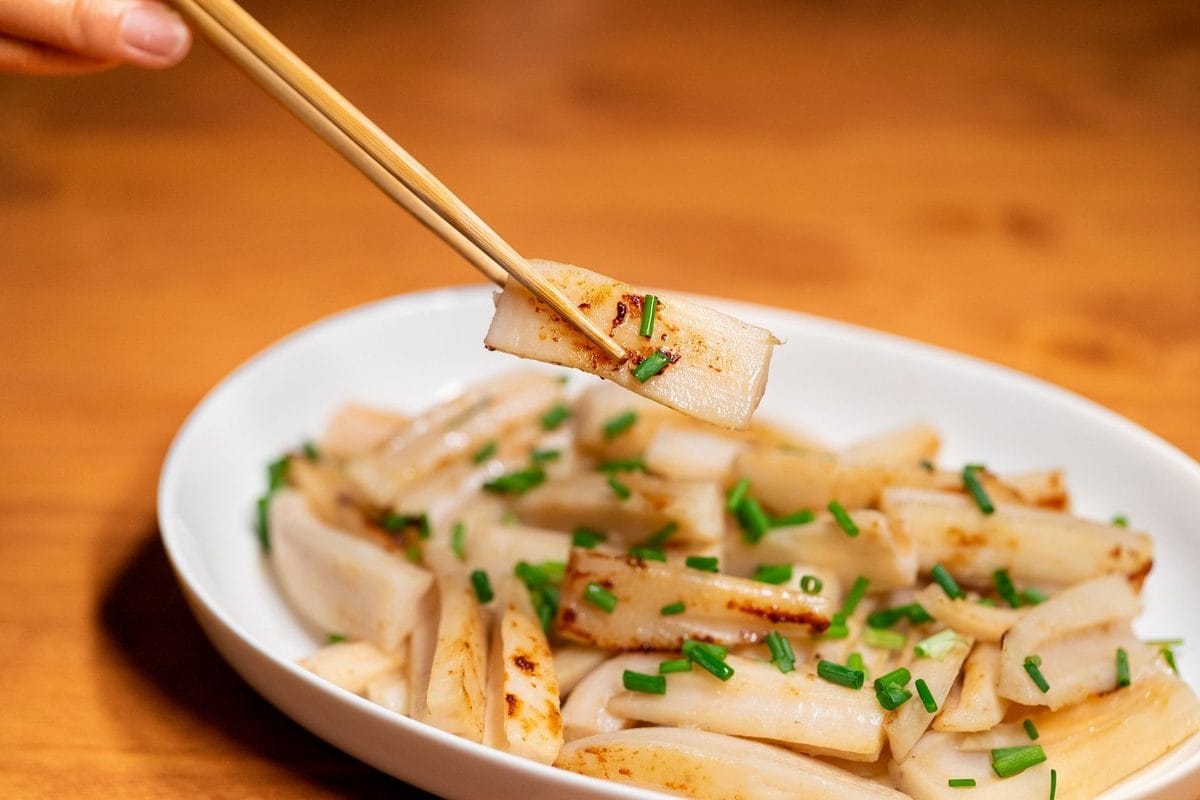
The best way to eat day-old nian gao, and I'll defend this against the people who eat it plain, is to cut it into slabs, dredge them in beaten egg, and pan-fry them until the outside crisps and the inside melts back into that warm pull. In the Philippines the same cake travels under the Hokkien-derived name tikoy and gets the identical egg-fry treatment, a small map of where Fujianese traders settled centuries ago. Shanghai, meanwhile, takes nian gao in an entirely savory direction, stir-frying the white ovular slices with pork and leafy greens until they're tender. The catch with all of them is timing: fresh from the steamer it's too soft to fry and too sticky to slice cleanly, so the good cooks wait a day on purpose.
The Southeast Asian Branch
Further south, glutinous rice cakes shed the New Year solemnity and lean into coconut, palm sugar, and banana leaf. Filipino kakanin is a whole sweet-snack genre built on the grain: kutsinta steamed into jiggly amber discs, sapin-sapin layered in tinted coconut strata, suman wrapped and boiled in leaves until it perfumes the whole bundle. In Indonesia and Malaysia, kue like the green-and-white kue lapis and the pandan-scented kuih do similar work, sold by the tray in wet markets before mid-morning.
What changes here is the seasoning logic. East Asian rice cakes are often deliberately plain so the grain and the occasion speak for themselves; Southeast Asian ones are perfumed up front with pandan, gula melaka, and coconut cream until the rice is almost a delivery system for those flavors. Vietnam splits the difference with bánh chưng, the dense square of glutinous rice, mung bean, and pork wrapped in dong leaves and boiled for the better part of a day for Tết. It's barely sweet, intensely savory, and unmistakably a rice cake even though almost no one outside the region would file it next to a strawberry daifuku.
How to Actually Buy and Keep It
Fresh rice cake has a short, unforgiving life, and this is where most first-timers go wrong. Pounded and steamed cakes start hardening within hours as the starch retrogrades, which is the technical name for that overnight stiffening you also see in day-old bread. A Korean injeolmi that was pillowy at noon will be stubborn by dinner. The fix is heat, not the fridge: a quick steam, a microwave with a damp cover, or a pan brings the chew back, while refrigeration actually accelerates the hardening.
If you're shopping the freezer aisle instead, Japanese kirimochi and vacuum-packed Korean garae-tteok keep for months and lose almost nothing, which makes them the sensible starting point. Buy the shelf-stable blocks first, learn what you like, then chase the fresh stuff from an actual rice cake shop once you know whether you're after the pounded stretch or the steamed crumble. Get the fresh injeolmi rolled in soybean powder if you see it; eat it the same afternoon, warm, before the starch wins.